
Face
How Much Weight Do You Have to Lose to See It in Your Face?
Short answer
Other people can usually see weight loss in your face once your BMI drops by about 1.33 points — roughly 8 lb for women and 9 lb for men of average height, according to a University of Toronto study (Re & Rule). To look noticeably more attractive or healthier, it took about twice that: around 14 lb for women and 18 lb for men. At a steady 1–2 lb per week, that means facial changes typically become visible to others within about 1–2 months. Weight loss doesn't change your bone structure, but it reveals more of it.
Key takeaways
- Noticeable threshold: ~1.33 BMI points (≈8 lb women, ≈9 lb men at average height).
- “More attractive” threshold: about double — ≈14 lb women, ≈18 lb men in the study.
- Taller people need more pounds for the same BMI change — see the table for your height.
- Very rapid loss can cause facial volume loss and laxity (“Ozempic face”), so pace matters.
What does the research say about facial weight loss?
In a study published in the journal Social Psychological and Personality Science, University of Toronto psychologists Daniel Re and Nicholas Rule showed participants pairs of digitally morphed faces of the same person at slightly different weights and asked which looked heavier. They found that people reliably detect a facial weight difference once it corresponds to about 1.33 kg/m² of BMI. Because they expressed the result in BMI, it can be applied to any height (University of Toronto; Faculty of Arts & Science).
For people of average height that's about 8 lb (women) and 9 lb (men). The researchers also found it takes roughly twice that change before a face is judged more attractive — about 14 lb for women and 18 lb for men.
How much weight do I need to lose to see it in my face, by height?
| Height | Others notice (−1.33 BMI) | Looks more attractive (≈2×) |
|---|---|---|
| 5′0″ (152 cm) | ≈ 7 lb (3.1 kg) | ≈ 14 lb |
| 5′3″ (160 cm) | ≈ 7.5 lb (3.4 kg) | ≈ 15 lb |
| 5′6″ (168 cm) | ≈ 8 lb (3.7 kg) | ≈ 16 lb |
| 5′9″ (175 cm) | ≈ 9 lb (4.1 kg) | ≈ 18 lb |
| 6′0″ (183 cm) | ≈ 10 lb (4.4 kg) | ≈ 20 lb |
| 6′3″ (190 cm) | ≈ 10.5 lb (4.8 kg) | ≈ 21 lb |
When do you start seeing weight loss in your face?
At the 1–2 lb per week pace the CDC recommends for lasting results, reaching an 8–9 lb loss takes roughly 4 to 9 weeks. Many people see their face look less puffy in the first week or two, but that early change is mostly water and reduced bloating (less salt and alcohol, better sleep), not fat.
- Weeks 1–2: less puffiness, mostly water.
- Weeks 4–9 (≈8–10 lb): others begin to notice — under-chin and jawline first.
- 2–4 months (≈15–25 lb): cheeks visibly leaner, cheekbones more defined; most people would call the face “slimmer”.
Does losing weight change your face shape?
It changes the soft tissue, not the bone. As facial fat decreases, the jaw angle, chin and cheekbones show more clearly, so a round face can look more oval or angular. Your underlying skull shape stays the same — weight loss reveals it rather than reshaping it.
Very fast or very large losses can also remove deep facial fat that gives the face its volume. The American Society of Plastic Surgeons describes how rapid weight loss — the so-called “Ozempic face” seen with GLP-1 medications — can leave sunken cheeks, hollow eyes and loose skin. Gradual loss, enough protein and strength training are commonly recommended to limit this.
Can I preview what my face will look like after weight loss?
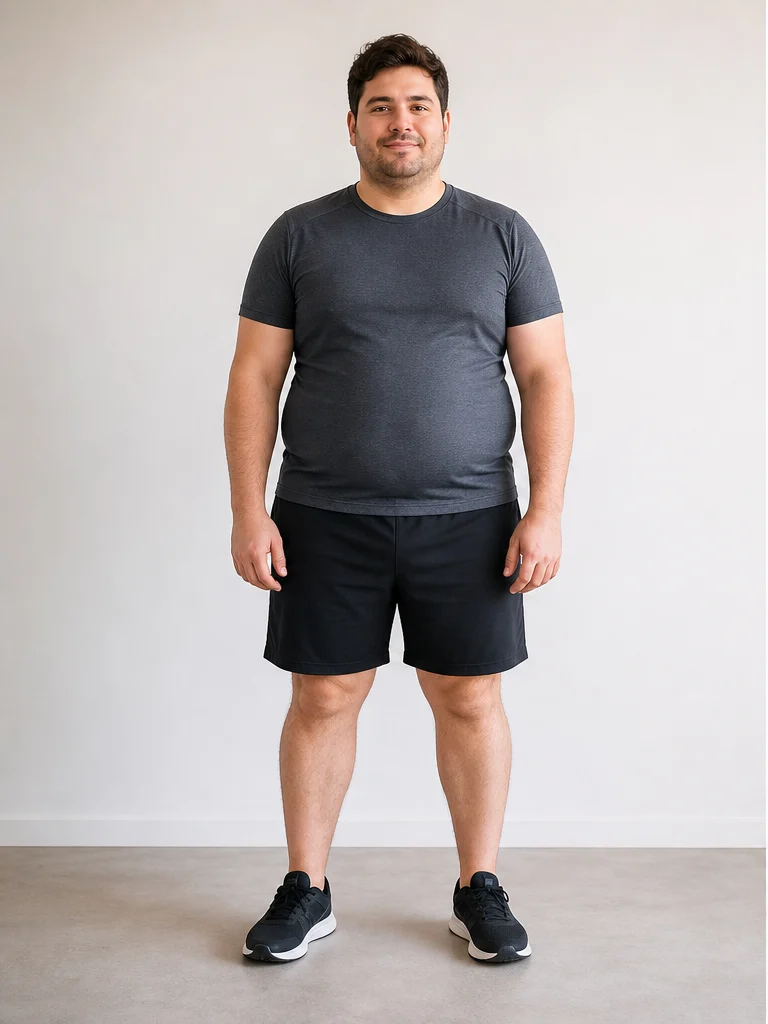
Yes. The face weight loss simulator edits a portrait photo to a target weight and keeps your identity — useful for seeing whether a 10, 20 or 30 lb goal changes your jawline the way you hope. Here is a real −10 lb edit on a demo photo:

 Now−10 lbs
Preview your face at your goal weight
Upload a front-facing portrait and compare your jawline and cheeks.
Frequently asked questions
Will losing 10 lbs make my face slimmer?
Is face fat the first or last to go?
How much weight do you have to lose before people notice?
Can you lose weight only in your face?
What is Ozempic face?
Sources
- University of Toronto — Losing weight can make you more attractive, experts say (Re & Rule, Social Psychological and Personality Science)Facial weight change of ~1.33 BMI points (≈8 lb women, ≈9 lb men of average height) is noticeable; roughly double that to look more attractive.
- University of Toronto Faculty of Arts & Science — Psychologists pinpoint change in weight required to look healthier and more attractive
- CDC — Steps for Losing WeightPeople who lose about 1–2 lb a week are more likely to keep it off.
- American Society of Plastic Surgeons — How plastic surgery can address “Ozempic face”Rapid weight loss can cause rapid facial volume loss and skin laxity.
This article is for general information and visualization only and is not medical advice. Talk to a qualified healthcare professional before starting a weight loss plan.